Three mornings each week, Fuma Ussene Macário, a 19-year-old community health activist, is one of the first to arrive at the Pele-Pele Health Facility in Pebane District, Zambézia Province, Mozambique. Macário became an activist to learn about health, serve her community, and pursue her childhood dream of becoming a nurse.
In the covered waiting area, she arranges colorful mats, homemade toys, and child-development materials. Soon, children explore toys, and caregivers join guided activities while waiting. Waiting time becomes a moment for learning, interaction, and play.
For Macário, facilitating these activities is much more than volunteering.
“I am helping the children in my community. I feel motivated when I see the mothers’ satisfaction as they learn about stimulation and the importance of talking to young children, because they did not know this before,” said Macário.
Community leaders selected Macário for the project because of her positive involvement and experience teaching the Quran to children at her mosque. Six months after the project ended, she and two other trained community health activists still help caregivers support their children’s healthy development and engage with health services.
“I continue to do these activities because I am helping the children in my community.”— Fuma Ussene Macário, community health activist


Macário teaching a caregiver simple ways to support her child’s development through play, communication, and responsive interaction. Photo: PATH/Rui Sepo.
Turning a vaccination challenge into an opportunity
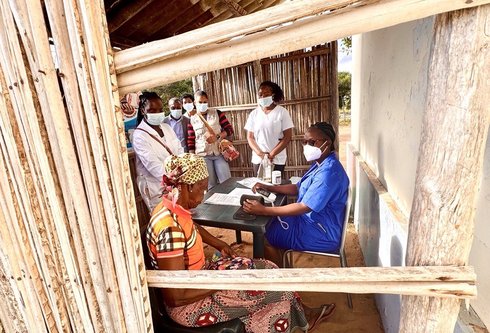
Pele-Pele Health Facility serves a predominantly rural area of Pebane District, where many families rely on farming, fishing, and small-scale trade and travel long distances for care.
When Mozambique introduced the malaria vaccine, health workers faced a challenge: unlike many routine childhood vaccines, it requires second and third doses one and two months after the first—visits that do not coincide with other immunization appointments, increasing the risk of missed doses.
Caregivers also had few opportunities during immunization visits to receive practical guidance on responsive caregiving, early learning, and child development.
Supported by Gavi, the Vaccine Alliance, and implemented by PATH in partnership with the national, provincial, district, and facility authorities, the Malaria Vaccine (MalVac) Learning Agenda Project addressed both challenges by using routine health contacts to promote vaccination, nurturing care, and early childhood development.
The intervention drew on a human-centered design (HCD) process used in Monapo District, Nampula Province. PATH and partners worked with caregivers, health workers, and community members to understand their realities, challenges, and priorities.
Interviews, observation, co-creation, and testing identified ways to integrate child development support into routine services without significantly burdening frontline health workers. Once capacity, job aids, and workflows were in place, the approach required little additional input and was acceptable to providers and caregivers.
The process also informed the development of an integrated national early childhood development (ECD) training package approved by Mozambique’s Ministry of Health. Based on global Care for Child Development guidance and adapted to local realities through HCD, it equips health workers to monitor milestones, counsel caregivers on responsive care, and encourage learning through play.
PATH and partners worked with caregivers, health workers, and community members to understand their realities, challenges, and priorities.

Turning waiting time into learning time
Implemented in ten health facilities across Pebane and Maganja da Costa Districts, the project’s most visible innovation—which Macário brings to life for so many children—is the Playbox, co-designed by PATH and health system actors and adopted for national rollout in waiting rooms.
In waiting areas for child health and vaccination services, trained activists guide caregivers through simple play and communication activities. They also show families how to make toys at home from materials such as cartons, bottle caps, cardboard, fabric, and sticks, extending early learning and responsive care beyond the facility.
Playbox sessions reached 3,020 caregivers in October, 3,998 in November, and 2,985 in December 2025; more than 80 percent were women. The sessions used routine visits to support early learning and responsive caregiving alongside child health services.
The Playbox shows that early learning need not be expensive: handmade dolls, locally made and recycled toys, mats, and illustrated counseling tools help caregivers support children through play, conversation, and responsive care.

Macário and her fellow health activists stand beside Playbox learning materials at Pele-Pele Health Facility in Pebane District, Zambézia Province, Mozambique. Photo: PATH/Elsa Maria Nhatumbo.
The Playbox complemented efforts to identify and follow up with children who had missed vaccinations. Between November and December 2025, 2,953 such children were identified, 94.6 percent of whom were not up to date with the malaria vaccine. The project period was too short for robust conclusions about coverage, but implementation improved monitoring and follow-up.
By making waiting areas more welcoming, the Playbox also strengthened relationships between families and health workers, combining vaccination and growth monitoring visits with learning about child development and parenting.
Building capacity that lasts
Sustainability was built in from the start. The project trained 38 health providers in ECD—18 in Pebane and 20 in Maganja da Costa—and 39 community activists—19 in Pebane and 20 in Maganja da Costa. At Pele-Pele, two health workers and three activists were trained: health workers counsel caregivers and monitor milestones, while activists facilitate Playbox sessions.
After implementation, the average number of reported cases of developmental delay across the ten facilities rose from 0.9 to 18.25 per month, suggesting stronger identification and reporting through routine services.
The clearest measure of success is what happened after the project ended.
Six months after the MalVac Learning Agenda Project ended—and after only three months of PATH-led technical assistance—the three trained activists, supported by the health worker providing routine child health and immunization services, still lead sessions three days a week. Amina Mateus Moiana, Preventive Medicine Technician at the facility, explains:
“One reason the Child Health Consultation and Expanded Program on Immunization teams continue this activity is the commitment of the community health activists, who voluntarily maintain the three-day-a-week schedule after the project ended. It is also rewarding to see children’s participation and the interaction between mothers and their children. These activities contribute to reducing missed vaccination appointments, and we have observed gradual improvement in completion of the four malaria vaccine doses.”
Today, the Playbox has become part of routine service delivery.
Six months after the MalVac Learning Agenda Project ended, the three trained activists, supported by the health worker providing routine child health and immunization services, still lead sessions three days a week.

Learning that extends beyond the facility
For Macário, the most meaningful changes happen after caregivers leave.
“I am also happy because some mothers said that, since they started interacting more with their children, they can easily notice when their children are not feeling well. Some mothers have also started making toys at home for their children.”
She saw this when two mothers returned for their next consultation with toys they had made after a Playbox session.
“I am happy when I see mothers paying attention and then doing at home what they have learned. This shows that our work is helping families,” she says.
The experience has also advanced Macário’s path toward becoming a nurse, giving her practical experience caring for children and working with families.
“I am happy when I see mothers paying attention and then doing at home what they have learned. This shows that our work is helping families.”— Fuma Ussene Macário, community health activist
Pele-Pele shows what becomes possible when health system actors and users co-design acceptable, feasible, and sustainable interventions. By embedding child development in routine child health and immunization services, building local capacity, and using materials that families can replicate, the project created an approach that communities could sustain and own.
Most importantly, it shows that enduring change is often carried forward by committed community members like Macário, whose dedication continues to help children learn, play, and thrive.