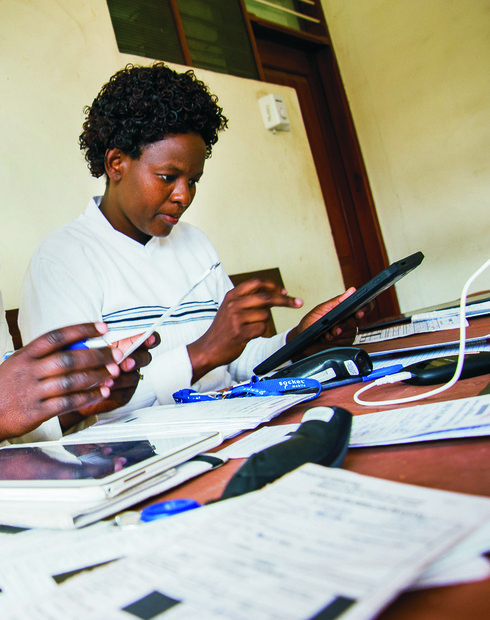
Across the countries where PATH works, ministries of health are asking how to use artificial intelligence, data, and digital tools in ways that strengthen national health systems instead of fragmenting them further. PATH's response is two new regional innovation centers, one for Africa and one for the Asia Pacific region, working alongside a global function led by Chief AI Officer Dr. Bilal Mateen.
Dr. Samuel Wambugu, director of the Africa center, is a health informatics specialist with more than two decades of experience strengthening data and digital systems across the continent. He has led PATH's work on the US Centers for Disease Control and Prevention's Technical Assistance Platform. Sameer Kanwar, director of the Asia Pacific Center, has built PATH's South Asia digital health, medical technology (MedTech), and AI portfolio and championed our South-South collaboration work.
Q: How are ministries of health in your regions thinking about AI and digital health right now?
SW: Ministries across Africa want AI, data, and digital capabilities that fit their own country and regional priorities, including those set through bodies like the Africa Centres for Disease Control and Prevention. What they are asking for is help moving from fragmented tools and pilots toward integrated, country-led, interoperable, secure, and sustainable digital and AI-enabled health systems. That shift is what the Africa regional innovation center is set up to support.
SK: The Asia Pacific region is one of the world's most dynamic digital transformation landscapes. Governments are increasingly defining their own digital health and AI agendas, with significant investment in digital public infrastructure, data systems, and AI-enabled service delivery. The boundaries between digital health, AI, and MedTech are narrowing, and many of the solutions in these areas are now emerging from and for the Global South. Our work supports country ownership, contextual adaptation, and sustainability, ensuring initiatives sit within national health priorities.
Q: Where is this approach being utilized now?
SW: Our primary health care strengthening work across Kenya, the Democratic Republic of the Congo, India, and Nigeria is one of the clearest examples. We are integrating AI-enabled decision support, digital case management, quality-of-care measurement, and broader system strengthening into real-world service delivery. The objective is to reduce diagnostic delays and expand access to primary care, with the digital and data foundations built to last beyond any single project cycle.
SK: South-South collaboration is where the work is most visible. With the governments of Kenya, Sri Lanka, and Indonesia, we are adapting and piloting proven digital and AI-enabled health solutions to each country's priorities and health system context. The work moves beyond isolated pilots toward structured, government-led pathways for technology transfer, contextual adaptation, and long-term scale-up. The milestone we are working toward is a replicable model for technology exchange across the Global South.
Q: What is the hardest question you are taking on?
SW: How ministries can benefit from AI without creating another wave of fragmented pilots, weak governance, poor-quality data, and tools that cannot be sustained. AI should be treated as a health system capability, rather than a standalone technology product. Responsible AI requires trusted data, interoperable systems, cybersecurity, ethical governance, workforce capacity, financing, and local accountability. Our role is to help ministries identify practical AI applications while strengthening the foundations to ensure AI use is safe, effective, equitable, and sustainable.
SK: South Asia is emerging as a leading ecosystem for applied AI, driven by digital infrastructure, entrepreneurial innovation, growing investment, and demand for scalable solutions. Platforms such as the India AI Impact Summit, held in New Delhi in February 2026, are positioning the region as a key voice in defining how AI can work for the Global South. The unresolved questions sit around governance, trust, and sustainability. How do we ensure responsible use of health data, mitigate bias, validate AI solutions across diverse settings, integrate them into clinical workflows, and create regulatory and financing models that enable equitable adoption within public health systems? These are the questions the hub is designed to address.
Dr. Samuel Wambugu directs PATH's Regional AI, Data, and Digital Innovation Center in Africa. Sameer Kanwar directs PATH's Regional AI, Data, and Digital Innovation Center in Asia Pacific.