Across the global health sector, an ongoing, positive shift is underway. From the 2023 Lusaka Agenda to the 2025 Accra Reset and the many conversations that came before, in between, and after, it is clearer than ever before that sustainability and sovereignty are top of mind for our partners. Local leaders understand their communities, their health systems, and their priorities in ways that no outside organization can replicate.
That's why we're placing local expertise at the center of one of the most high-impact areas of our work: artificial intelligence (AI), data, and digital innovation. I’m proud to announce that we have established new Regional AI, Data, and Digital Innovation Centers, in Africa and Asia Pacific.
These regional innovation centers are fundamental to how PATH will operate in these regions, ensuring solutions align with country priorities and local context. By grounding our work in the realities of how health systems function, we can achieve sustainable impact, together.
Each center will be led by someone with both the expertise and the relationships to make that vision real.
“By grounding our work in the realities of how health systems function, we can achieve sustainable impact, together.”

Sameer Kanwar will lead the Asia Pacific (APAC) center, based in India. The region is already a hub of innovation, where we have been working with governments across APAC countries to develop a successful digital health ecosystem for many years. In Indonesia and Sri Lanka, we are piloting proven digital health and AI solutions to strengthen government-to-government technology transfer. In Fiji, Kiribati, Tuvalu, and the Solomon Islands, we conducted landscape assessments of digital health infrastructure, policy, governance, and capacities, alongside a regional telemedicine landscape covering 18 Asia-Pacific countries. And in Vietnam, we worked with local partners to improve patient data systems, enabling better tracking of HIV infections nationwide. Sameer spearheads these projects with proven leadership skills in digital health and AI, along with deep connections with health ministries across the region.
In Africa, Dr. Samuel Wambugu will lead the regional center. A health informatics expert from Kenya, Samuel is currently president of the Global Digital Health Network, one of the world's largest development-focused digital health communities. He’s also project lead for a US Centers for Disease Control and Prevention project focused on improving health outcomes through better data collection and analysis. He is exactly the kind of leader this work demands, and he’ll be overseeing and growing an already robust portfolio of work in the region. In Kenya, we helped strengthen the national data repository and informatics maturity assessments. PATH has supported cybersecurity assessments and country-owned action plans in Côte d’Ivoire, the Democratic Republic of the Congo, and Zimbabwe. And in Malawi and Uganda, we are partnering with the governments to develop and scale a strong digital health architecture.
In both regions, this is just the beginning, as we are seeing growing demand for trusted partners who can connect AI, data, and digital systems to build modern, resilient health systems.
The regional innovation centers will receive the highest level of support through our Chief AI Officer Bilal Mateen. Bilal previously led PATH’s Digital Square initiative—a foundational $180m effort to drive digital transformation across 33 African and Asian countries. He has long been an advocate for strong regulatory standards and safeguards around AI and data collection in health care. Earlier this year, he was appointed to the United Nations’ first Independent International Scientific Panel on Artificial Intelligence. Now, as part of a new global AI, data, and digital health initiative, Bilal’s team is the connective tissue linking the new regional centers with our global practice.
That global backbone will ensure standards and learnings are shared broadly, while driving a world-leading research agenda across biomedical science and health. Centering local expertise will ensure that the work remains grounded in local priorities, and that PATH is helping to shape a sustainable marketplace for the innovations we help develop.
AI, data, and digital health at PATH
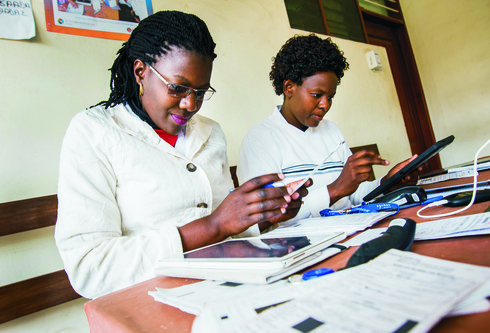
Learn moreThis structure reflects a broader truth. Data, digital tools, and AI are no longer standalone areas of global health work. Used effectively and ethically, they will be central to the future of community health around the world. It’s already happening. We’re already seeing the impact. In Kenya, PATH helped develop an LLM-enabled clinical decision support system that helps health workers ensure treatment plans match with symptoms and diagnosis. In Nigeria, we developed an AI-enabled information hotline for community health extension workers—a vital part of the health system in many regions where doctors may be in short supply. And in Rwanda, we’ve worked with the government to pioneer the use of ambient listening, much as we’re seeing in high-income countries to support documentation, but in this case, as a supportive supervision tool to ensure that the right patients are being referred, at the right time.
These exciting efforts are underpinned by PATH’s new Strategy 2030, an ambitious roadmap designed to maximize our impact at every level. Our new strategy emphasizes locally led progress and practical solutions—intentional choices meant to prioritize sustainable solutions that will deliver meaningful results into the future.
The goal is that our work can be the way to better health for the communities we serve, long after we’re gone.