When Mozambique introduced malaria vaccines in August 2024, it marked an exciting step forward in the fight against one of the leading causes of illness and death among young children in the country. Malaria is a significant health threat in Mozambique, accounting for 3.5 percent of global cases and 3 percent of global deaths in 2023.
In high-burden provinces like Zambézia, which is in the country’s central-coastal region, the vaccine offers a way to prevent children from getting malaria and to reduce the severity of cases. But introducing a vaccine is only the first step—children must receive all four doses of the malaria vaccine to receive the best protection.
In Pebane and Maganja da Costa, two districts located on Zambézia’s coastline, routine immunization data showed a concerning trend: many children were receiving the first dose of the malaria vaccine but not returning for subsequent doses. Caregivers were often unaware of the four-dose vaccine schedule, and many families in remote communities faced significant barriers to accessing health services.
To address these challenges, PATH, which is providing technical assistance to the Mozambique Ministry of Health on malaria vaccine implementation, looked to existing resources within communities: local health workers and health committees.
Building on what works
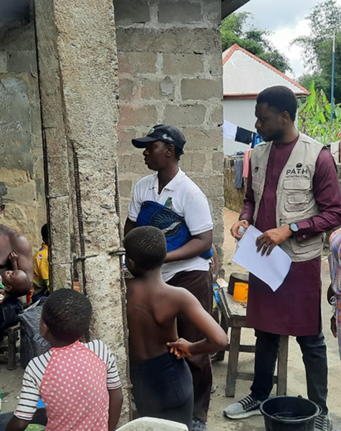
Across Mozambique, community health workers—known as Agentes Polivalentes de Saúde (APS)—and community health committees are deeply embedded in the areas they serve. Health committees, comprised of religious, traditional, and other influential leaders, act as a bridge between families and services. They know local families, understand caregivers’ concerns, and are often the first trusted points of contact for health information.
In Pebane and Maganja da Costa, as well as in selected districts in the north-west central province of Tete, PATH worked with district health teams to integrate malaria vaccine promotion into existing community-led programs. The goal was simple: by training APS and health committee members, bring vaccine information and support closer to families.
Between October 2025 and April 2026, PATH trained 400 community members, including APS and health committees, as well as 60 health workers in Tete and Zambézia Provinces. The training focused on interpersonal communication, including during immunization sessions; listening to and engaging influential groups in communities; addressing vaccine misconceptions; and identifying children who had missed doses.
The result of the training was a stronger partnership between health facilities and partners like APS and health committees—one that connects demand generation with practical follow-up.
Turning community engagement into action
Today, these trained community leaders are playing a central role in helping children stay on track with their malaria vaccinations.
Their work begins with identifying where coverage gaps exist. During household visits and community discussions, APS and health committee members identify children who have missed doses. They then share this information with health facility staff, who compare this information with data from immunization records to develop a clearer picture of where support is needed. Together, they use this information to plan outreach activities and mobile vaccination brigades that can reach underserved areas.
APS and health committees also organize household visits, community dialogues, and public awareness sessions. These conversations create safe spaces for caregivers and others in the communities to ask questions about the malaria vaccine and learn about the importance of completing all four doses.
These conversations create safe spaces for caregivers and others in the communities to ask questions about the malaria vaccine and learn about the importance of completing all four doses.
Perhaps most importantly, APS and health committee members help track children who have missed appointments. Working alongside health facility staff who have themselves received training related to improved data quality and use, the community members visit families and help connect them with upcoming vaccination opportunities.
“Regarding the tracking of children who missed vaccination, the training provided to technicians [health workers] and vaccination focal points has greatly supported the recovery of defaulter children and, consequently, the reduction of zero-dose and under-immunized children,” said Rui Sepo, the District EPI Lead in Pebane. “These results also stem from the work being carried out by community actors who were trained in demand creation mobilization.”
Early results show promise
Thanks to the consistent work of APS and health committees, PATH and district health teams have already observed greater awareness among caregivers about the full vaccine schedule. From November 2025 to June 2026, trained community members across the two districts conducted more than 6,100 community talks, completed nearly 75,000 household visits, and referred more than 1,100 children with incomplete vaccinations for follow-up.*
The success of the approach is best reflected in the stories of caregivers like Nélia, a mother of twins who lives in Maganja da Costa. After learning about the malaria vaccine during a visit to her local health center, she resolved that her children would complete the full schedule.
“I was not aware of the vaccine at first,” Nélia said. “A health provider told me about it during a visit to Muzo Health Centre when my children were six months old. When I heard that the vaccine could help protect my children against malaria, I decided that I would not miss any dose.”
Despite the responsibilities of caring for two young children, managing her household, and travelling to the health facility for each appointment, Nélia was committed to ensuring that the twins received all four recommended doses.
“All my children have completed all doses of the malaria vaccine,” she said. “I urge all the other mothers to take their children to the health unit to get the malaria vaccine.”
“When I heard that the vaccine could help protect my children against malaria, I decided that I would not miss any dose.”— Nélia, a mother who lives in Maganja da Costa, Mozambique
A model for success
Stories like Nélia’s highlight the value of investing in community partners to improve malaria vaccine uptake and completion. Existing structures, like APS and health committees, already have trusted relationships within communities, making them powerful entry points for demand generation activities.
The program in Pebane and Maganja da Costa also shows the importance of integrating demand generation activities with tracking and follow-up. For a multi-dose intervention like the malaria vaccine, promotion and awareness must correspond with follow-up mechanisms to remind caregivers about subsequent doses.
As Mozambique continues to scale up malaria vaccination across the country, the experience from Pebane, Maganja da Costa, and other districts offers a reminder that successful interventions are grounded in the communities they serve. By working with trusted local community members, countries can strengthen malaria vaccination uptake, improve routine immunization coverage more generally, and help more children receive the protection they need.
* Data source: Summary of RED-REC focal points, November 2025-June 2026, Pebane and Maganja da Costa districts.