Digital health is reshaping how care is delivered across India. But as states work to translate policies and platforms into everyday use, the challenge is about making digital health work within real health systems, existing workflows, and people’s lives.
In Indian states of Andhra Pradesh, Maharashtra, and Odisha, PATH is working with governments and partners to strengthen digital health ecosystems, improve interoperability, digitize primary care, and support more coordinated care.
We spoke with PATH experts working across the three states about what they are learning from implementation and what it takes to make digital health relevant, usable, and sustainable.
What does digital health need to solve before it can make a difference?
Sudheer Nadipally and Charan Tej: In Andhra Pradesh, we are working closely with the government to support the implementation of the Ayushman Bharat Digital Mission (ABDM). A key focus is helping public and private health care providers adopt interoperable digital health systems and connect existing hospital systems and applications to the ABDM ecosystem.
When digitizing systems, the challenge is ensuring these systems can communicate with one another so that information can move more seamlessly across providers and facilities.
Through the Model District and Model Facilities Initiative in Srikakulam district, we are demonstrating how coordinated implementation across public and private health care facilities can contribute to a more connected patient journey. The aim is to generate practical learnings that can inform scale-up across the state.
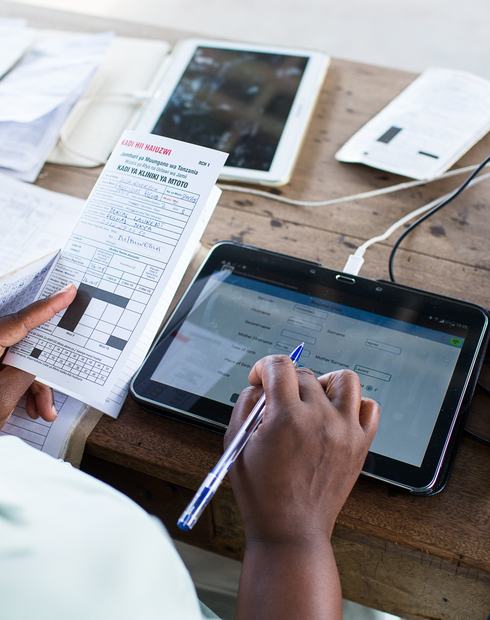
Deepika Khaladkar: In Maharashtra, our focus is on digitizing primary health care across Nashik, Chhatrapati Sambhaji Nagar, and Amravati districts. A key part of this work is enabling the Electronic Secure Unified Comprehensive Health Interface (eSUCHI).
eSUCHI is designed as a single point of data entry and an offline job aid for frontline health workers. It aims to make digital systems more useful at the point where health care is delivered while improving data visibility across the primary care system.
The platform has helped reduce the time required to prepare routine reports and provided ASHA workers with a single platform to relay their work, pending tasks, and work plans. The project has also supported the identification and mapping of private providers and facilities.
Pallavi Jain: In Odisha, we are approaching digital health through the patient journey. We are supporting the Government of Odisha in designing and implementing an ABDM-enabled Care Coordination (AECC) model for the public health system, which is currently being piloted in Keonjhar district.
The model will enable citizens to access care through multiple digital channels, book appointments, receive AI-assisted guidance on the appropriate department, and obtain digital tokens to reduce waiting times. It will also support health care providers with AI-enabled clinical documentation and longitudinal health records linked to Ayushman Bharat Health Account (ABHA), while connecting diagnostics, pharmacies, referrals, and follow up care.
What are some of the biggest challenges to making digital health work in practice?
Sudheer Nadipally and Charan Tej: One of our biggest challenges has been helping people understand the value of digital transformation and building confidence in how these systems will work in practice.
For example, citizens may be willing to create an ABHA but still need support to complete OTP-based registration, link their health records, and eventually use Personal Health Record applications. Health care providers and other stakeholders may also have concerns around privacy, workflow disruption, and operational feasibility.
To address this, we demonstrated how ABDM can complement existing Hospital Management Information Systems by simplifying patient registration, enabling secure health record sharing, and improving continuity of care without adding to health care workers’ workload.
Stakeholder consultations, field demonstrations, and continuous engagement have been important in addressing concerns and building trust.
Deepika Khaladkar: In Maharashtra, shifting private providers from paper-based processes to technology-enabled approaches required sustained sensitization, regular engagement, and support to adopt ABDM-compliant systems. Citizens also had concerns about Aadhaar linkage and OTP verification, making awareness and trust-building an important part of implementation.
Another challenge has been adapting the application once it reaches the field. Even after user acceptance testing and incorporating field suggestions prior to deployment, new needs and workflow changes emerged as health workers began using eSUCHI during routine service delivery.
We therefore had to make course corrections and customize the technology based on what we were learning in real-world use.
That experience reinforced an important lesson: a digital solution is not finished when it is launched. It needs to continue evolving with its users and the context in which it is being used.
Pallavi Jain: In Odisha, change management has been one of the biggest challenges. Introducing digital intervention often means asking people to change an existing way of working, so it is important to explain why the change is needed and what value it can bring to both providers and citizens.
Some digital health concepts can also be difficult to understand initially. Translating technical concepts into simple, relatable use cases has therefore been essential for meaningful stakeholder engagement.
At the same time, digital health involves multiple stakeholders. Bringing together government departments, health care providers, technology partners, and other ecosystem actors around a common vision and shared way of working has been both challenging and critical to moving the program forward.
How do you make digital health relevant to the people who will use it?
Sudheer Nadipally and Charan Tej: We begin with the everyday challenges that health-care providers and citizens already experience—such as long registration queues, repeated paperwork, fragmented health records, or difficulty accessing previous medical history.
When people can see how a digital solution responds to a problem they already face, it becomes easier to demonstrate its value.
But different stakeholders also have different priorities. A clinician, frontline health worker, hospital administrator, policymaker, and citizen may each experience the health system differently.
Our engagement therefore uses practical use cases, demonstrations, and implementation experiences that are relevant to different stakeholders. More importantly, we work collaboratively with stakeholders to develop solutions that fit existing workflows rather than asking people to completely change the way they work.
Deepika Khaladkar: We have found that digital tools need to reflect the realities of frontline health workers. We therefore customized eSUCHI to align with existing registers and portals and introduced a local-language option to support uptake.
Detailed training has been important in helping ASHAs, ANMs, and other frontline workers use digital tools effectively.
Government ownership has been another important factor. By collaborating with district administration from the outset and driving field activities through government authorities, we have helped ensure that implementation is owned by block and field staff and becomes part of routine activity.
Pallavi Jain: Co-design and collaboration are central to our approach. Digital health interventions cannot be developed in isolation because they need to work across the health system and for the different stakeholders involved in delivering and receiving care.
The starting point should be a deep understanding of the problem, existing workflows, and the needs of the people who ultimately use and experience the solution. Technology should then be selected and tailored to address those needs.
Sustaining digital transformation beyond implementation
Across Andhra Pradesh, Maharashtra, and Odisha, the experience is clear: digital health succeeds not simply when technology is deployed, but when it becomes useful, trusted, owned, and embedded within the health system.
Interoperability matters. So does user-centered design, government ownership, stakeholder engagement, and the willingness to listen and adapt after implementation begins.
Ultimately, the measure of digital transformation is whether it makes it easier for people to deliver and receive care and whether health systems can sustain and improve those solutions over time.
About the team
Sudheer Nadipally, State Lead, and Charan Tej, Program Officer, support the Government of Andhra Pradesh in implementing ABDM and strengthening interoperable digital health systems.
Deepika Khaladkar, Senior Program Officer, works with the Government of Maharashtra to support digital innovations and strengthen primary health-care delivery.
Pallavi Jain, Regional Lead, Digital Health & AI, Asia Pacific, leads work on digital health and AI, strategic partnerships, and scaling country-led solutions across the Asia-Pacific region.