Physical inactivity remains a significant public health concern in Vietnam across age groups. National data show that 22.2 percent of Vietnamese adults aged 18–69 do not meet recommended levels of physical activity. The challenge is even more pronounced among adolescents: 91 percent of girls and 82 percent of boys aged 11–17 do not meet the recommended 60 minutes of daily physical activity.
This growing inactivity is particularly concerning given Vietnam’s high burden of noncommunicable diseases (NCDs), which account for around 80 percent of all deaths in the country. Physical inactivity places adolescents at heightened risk of NCDs and affects not only their physical health, but also their mental well-being and overall development. Addressing this challenge requires coordinated efforts that influence how young people live, learn, and move every day.
The Community Sport and Health Cooperation Initiative, initiated by the International Olympic Committee (IOC) and delivered in collaboration with the World Health Organization (WHO) and PATH, aims to strengthen the contribution of sport and physical activity to building healthy and active communities. PATH is the delivery lead, running the initiative in Ghana, Tanzania, Nepal, Peru, and Vietnam.
In Vietnam, the initiative is implemented in collaboration with Vietnam Olympic Committee, Vietnam Authority of Sports, World Health Organization, the Nghệ An Department of Education and Training, and other local and international partners.
Across 10 pilot schools in Nghệ An province, alongside nationwide communication and engagement activities, the initiative focuses on four interconnected areas:
- raising awareness on sport and health;
- promoting regular sport and physical activity in schools and communities;
- strengthening multisectoral collaboration and policy advocacy;
- and generating evidence to support sustainability and scale-up.
Building awareness as the foundation for change
At the 10 pilot schools, the initiative began with orientation and training for school leaders, focal teachers, and physical education teachers, introducing the initiative and providing practical guidance on activity planning and implementation. Core teams and Zalo groups (a widely used messaging platform in Vietnam) were then established to support ongoing coordination, allowing schools to share progress, exchange lessons learned, and address implementation challenges in a timely manner. E-learning modules complemented this support by providing educators with accessible resources to reinforce knowledge and support consistent implementation.
To equip schools and communities with practical resources, a comprehensive set of communication and educational materials was also developed with technical input from WHO, the National Olympic Committee (NOC), the Viet Nam Administration of Sports (VAS), the Ministry of Health (MOH), the Ministry of Education and Training (MOET), and experts from national sports universities. These materials provide practical guidance for teachers, schools, and parents, helping translate awareness into sustained behavior change both in schools and at home.

A comprehensive set of communication and educational materials. Photo: PATH.
Building on this foundation, the initiative combines deep, school-based engagement with broad, population-level outreach through a multi-channel communication approach. At the national level, digital platforms play a central role.
The “The Thao Moi Ngay” (Sports Every Day) Facebook page and an updated website provide accessible information and knowledge on sport and health, share regular updates on activities and events, and disseminate practical communication content to students, teachers, parents, and the wider public. These platforms also create opportunities for students and communities to engage, interact, and participate in physical activities.
To drive engagement at scale and low cost, the initiative implemented interactive online campaigns and competitions that encouraged people to take part in physical activity and share their experiences with others. The "Virtual Sports Performance Competition" invited participants to showcase their creativity and physical activity through online sport performances, while the “How Sports Changed Me” contest encouraged participants to share personal stories about how sport had positively influenced their health and daily lives.
Together, these activities attracted nationwide participation and generated more than 270,000 interactions within a short period, significantly amplifying positive messages around sport and health.

Participants across Vietnam enthusiastically took part in competitions organized as part of the initiative, celebrating the joy of sport and physical activity. Photo: PATH.
At the same time, within the 10 pilot schools, communication is deeply embedded into daily school life through flag-raising ceremonies, school broadcasts, interactive activities, and student-led communication sessions promoting 60 minutes of physical activity per day, delivered by School Sports Ambassadors and students.
These peer-led activities create opportunities for students to actively engage with and promote sport and health among their peers, helping ensure that messages are not only visible, but consistently reinforced in students’ everyday environments.
Together, this approach—combining engagement in schools with the scale of digital and nationwide outreach—is helping shift mindsets and position sport and physical activity as an essential part of a healthy lifestyle.
Translating awareness into daily practice
Awareness creates intention, but habits are built through daily practice.
Across the 10 pilot schools, with leadership from the Nghệ An Department of Education and Training (DOET) and support from PATH, the initiative focuses on embedding physical activity into everyday school routines through practical, low-cost, and scalable solutions—including sports clubs, active breaks, and school-wide activities. Nghệ An DOET has also provided guidance to schools to integrate physical activity into their annual plans, helping create an enabling environment for these practices to be sustained beyond individual activities.
These efforts have already translated into tangible changes in school environments. Between January and May 2025, the total membership of sports clubs across the 10 pilot schools increased from 1,661 to 1,860 students. Schools that previously had no sports clubs, such as Thai Nguyen and Tho Loc Secondary Schools, established new volleyball and badminton clubs, creating more opportunities for students to participate in regular physical activity.
At the core of this approach is the School Sports Ambassador initiative—a student-led model that empowers young people to identify challenges, propose solutions, and lead activities within their schools. By positioning students as drivers of change, the model strengthens participation while building ownership and long-term sustainability.
“As School Sports Ambassadors, we identify challenges and find ways to improve physical activity at school. Through small daily exercises, we encourage others to be active, helping us feel healthier, happier, and more connected.”— Cao Khanh Linh, a student from Dang Thai Mai Secondary School


The School Sports Ambassador program allows students to implement practical, low-cost, scalable solutions to increase physical activity at schools. Photo: PATH/Ha Nguyen.
“Students have become more interested in sports and are gradually building daily physical activity habits. As a result, both their physical and mental health have improved. They are healthier, happier, more confident, and more engaged in school activities. These positive changes are also spreading to families, as parents become more supportive of physical activity for their children.”
— Ms. Nguyen Thi Thuy, teacher at Dien Tan Primary School
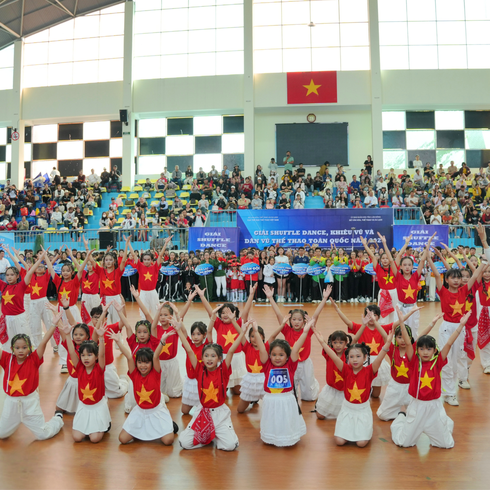
Beyond the pilot schools, the initiative also contributes to provincial and national events, including the National Shuffle Dance, Dance Sport, and Sports Folk Dance Competition, held in Hai Phong in 2024 and Da Lat in 2025, as well as the Provincial School Sports Day in Nghệ An—extending reach and engagement to the wider population.
Together, these approaches are not only integrating sport and physical activity into school life, but also expanding active lifestyles beyond schools into communities.

PATH joined and supported the Vietnam’s 2025 National Shuffle Dance, Sport Dance, and Folk Dance Competition in Da Lat. Photo: PATH.
Creating sustainable, long-lasting impact
Sustaining and scaling up these changes depends on strong, system-level support.
A defining strength of the initiative is its multisector collaboration, bringing together stakeholders across health, education, and sport. This collaboration has been institutionalized through a multisector technical working group, comprising representatives from WHO, NOC, VAS, MOH, and MOET, providing strategic guidance and technical oversight throughout implementation.
“The initiative has delivered clear impact and achieved broad outreach through its innovative, practical, and community-centered approach. Students were empowered to actively propose and lead activities, while strong cross-sector collaboration among the sports, health, and education sectors played a critical role in the initiative’s success. These achievements demonstrate strong potential for scaling up the model across provinces in Viet Nam and adapting it at the international level.”
— Mr. Tran Van Manh, Secretary General of the Vietnam Olympic Committee

A technical working group meeting organized at NOC, with the presence of representatives from WHO, NOC, VAS, MOH, and MOET. Photo: PATH.
At the policy level, Nghệ An DOET—supported by PATH—has issued official guidance to integrate physical activity into school plans. As a result, schools are now embedding physical activity into their annual plans, with strong support from local authorities.
“This program is highly practical and adaptable. It can be scaled beyond the initial 10 schools to others across the province, including remote areas, because it fits well with students’ needs and school conditions.”— Mr. Nguyen Trong Hoan, Chief of Office, Nghệ An DOET

Results and early impact
By the end of the project, outcomes significantly exceeded initial targets:
- More than 2.1 million people reached through communication and engagement activities promoting physical activity for health
- Over 257,000 students and community members supported in maintaining regular physical activity
- A 20.6 percent increase in the proportion of students achieving sufficient and regular physical activity across the 10 pilot schools
- 847 teachers, schools, and partners provided with capacity-building and technical support
- Nationwide competitions, school activities, and communication initiatives implemented across digital and offline platforms
- Practical sport-for-health communication and training materials developed and shared nationwide
Beyond these figures, qualitative changes are clear. Students are more active and confident, teachers are more engaged, and schools are increasingly integrating sport into daily routines.
“The Community Sport and Health Cooperation Initiative has achieved many encouraging results, contributing to building and strengthening the foundation for a more sustainable physical activity ecosystem in schools and communities. PATH is honored to receive the support of the IOC, WHO and the trust and collaboration of the Ministry of Culture, Sports and Tourism, the Nghệ An Department of Education and Training, and many central and local partners who have worked together to make these achievements possible.”
— Dr. Le Thi Thu Hien, Director, Primary Health Care Program, PATH
Learning, adapting, and scaling what works
The initiative places strong emphasis on learning and adaptation, capturing implementation experiences through school visits, stakeholder consultations, and review workshops.
These insights are shared across schools and partners, allowing effective models to be refined and replicated. At the same time, ongoing communication and engagement activities continue to amplify successful practices and attract interest beyond the pilot.
“The results from this project in Nghệ An are especially promising. Reaching hundreds of thousands of people and helping them to be more active in daily life is a very significant achievement. I’m particularly impressed by the project’s focus on empowering students as leaders and advocates for physical activity in their schools and communities. This kind of sustainable, community-driven approach is essential for long-term impact.”
— Dr. Angela Pratt, WHO Representative in Vietnam
What began as a pilot in 10 schools is now building momentum as a broader movement. By connecting awareness, daily practice, and system-level support, the initiative is laying the foundation for long-term impact in Vietnam and beyond.
Reference:
- World Health Organization Regional Office for the Western Pacific. National survey on the risk factors of noncommunicable diseases in Viet Nam, 2021. WHO. February 7, 2025. https://www.who.int/publications/i/item/9789290620266
- World Health Organization. Physical activity Viet Nam 2022 country profile. WHO. October 19, 2022. https://www.who.int/publications/m/item/physical-activity-vnm-2022-country-profile
- World Health Organization. Viet Nam unites to tackle top causes of disease and death. WHO Viet Nam. December 15, 2025. https://www.who.int/vietnam/news/detail/15-12-2025-viet-nam-unites-to-tackle-top-causes-of-disease-and-death