In Nigeria, an estimated 2 million children suffer from severe acute malnutrition (SAM)—a life-threatening depletion of nutrients. Although SAM is easily treatable with a high-calorie dietary supplement, only one in five children receive care due to limited access to health facilities equipped with commodities and trained staff to treat malnutrition.
Closing the gap between diagnosis and treatment became an urgent goal for the Rotary Healthy Communities Challenge (RHCC) when community health workers (CHWs) in RHCC-supported communities reported that children with malnutrition could not access treatment at the local health facility. Through a collaboration between the Akwa Ibom State government, PATH, and Helen Keller Intl, temporary clinics brought treatment to communities and supported the screening and recovery of children.
Identifying the gap
Implemented by PATH and in partnership with local Rotary members, RHCC is supported by The Rotary Foundation and the Gates Foundation. The project provides technical and logistical support to the Akwa Ibom and Kebbi State primary health care development agencies to strengthen community-based health care for children through the implementation of integrated community case management (iCCM). iCCM provides quality care for the diagnosis and treatment of malaria, diarrhea, and pneumonia in children under five years of age through community-level health care, and referral for severe cases of these diseases. Trained CHWs serve as a critical bridge between households and health facilities, providing lifesaving health services and information to families in rural communities.
As a part of their training, CHWs learn to screen children ages 6–59 months for malnutrition using mid-upper arm circumference straps—a simple, color-coded tool that can reveal whether a child is at risk based on the circumference of their arm. The green zone indicates a healthy child, yellow signals moderate malnutrition, and red denotes SAM and the need for immediate referral to a health facility for treatment.
After RHCC-supported services launched in October 2025, CHWs in Akwa Ibom State began identifying children with SAM and referring them to nearby health facilities. However, when these families arrived, they could not receive services—the facilities did not have trained staff, or the specialized therapeutic food needed to treat SAM.
The missing piece
Also in Akwa Ibom, Helen Keller Intl, through its Founders Pledge-funded Life Saving Nutrition Project under their Project Resource Optimization (PRO) program, trains health workers and stocks facilities with ready-to-use therapeutic food in four local government areas. However, these areas did not overlap with the RHCC-supported communities where children with malnutrition were identified.
To address the gap in nutrition services in RHCC-supported areas, PATH, the Akwa Ibom State Primary Health Care Development Agency, Helen Keller Intl, and the State Nutrition Unit joined forces to provide lifesaving services for children in the state. After a series of planning meetings, the group designed an innovative solution: 12 temporary nutrition out-patient therapeutic program (OTP) clinics established in two locations within each of the six RHCC-supported local government areas—Ikono, Ibesikpo Asutan, Eket, Onna, Oruk Anam, and Nsit Ibom.
Six days that sparked change
From April 13 to 18, 2025, CHWs fanned out across their communities, reaching out to caregivers of children who had already been identified as malnourished to refer them to the temporary OTP clinic. The response was overwhelming.
“I didn't know what to do until the CHW assigned to my community visited... I agreed to come on the day of the clinic as I was told because I had no other option. It is still like a miracle to me, because my son is now fully recovered.”— Mother of a recovered child, Akwa Ibom State
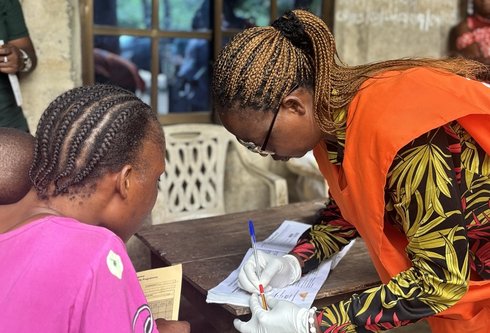
Helen Keller Intl and the State Nutrition Unit teams set up clinics to screen and classify cases of malnutrition. Children with moderate malnutrition received micronutrient supplements and counseling. Those with SAM were enrolled into treatment and given weekly weight-based rations of ready-to-use therapeutic food or RUTF, a nutrient-dense, high calorie peanut-based paste that provides life-saving nutrition.
In just six days, 323 children were screened. Of these, 108 children were diagnosed with a form of acute malnutrition—including 58 with SAM, who were enrolled in treatment immediately. This care came at no cost to families. Helen Keller Intl covered nutrition services, allowing families to access lifesaving care without financial barriers.
“I was worried I would not be able to afford the cost of treatment. The CHW told me it would be free. Now my daughter is fine, laughing and playing around. I hope this can be extended to other places.”— Mother of a recovered child, Akwa Ibom State

Caregivers and children gather at a temporary nutrition OTP clinic in Akwa Ibom State, Nigeria. Photo: Helen Keller Intl.
A local response becomes a lasting system
What began as a short-term emergency response revealed something larger: the demand for these services exceeded what anyone had anticipated. The nutrition OTP clinics drew in families whose children had never been tested before, proof of just how many children were slipping through the cracks.
Helen Keller Intl responded by expanding its Life Saving Nutrition Project to cover all six RHCC-supported local government areas in Akwa Ibom, and the SAM referral sites which started as temporary have become established SAM management facilities managed by Helen Keller Intl. Health workers will be trained, and facilities will be fully stocked, with the Akwa Ibom State Primary Health Care Development Agency overseeing the system's sustainability.
The communities of Akwa Ibom did not need more resources. They needed to be connected to existing resources—across funding streams, across organizations, across the gap between identification and treatment.
Leadership from the Akwa Ibom State Primary Health Care Development Agency is now exploring ways to institutionalize this collaborative model across the state. This experience demonstrated what is possible when organizations unite around a shared goal.