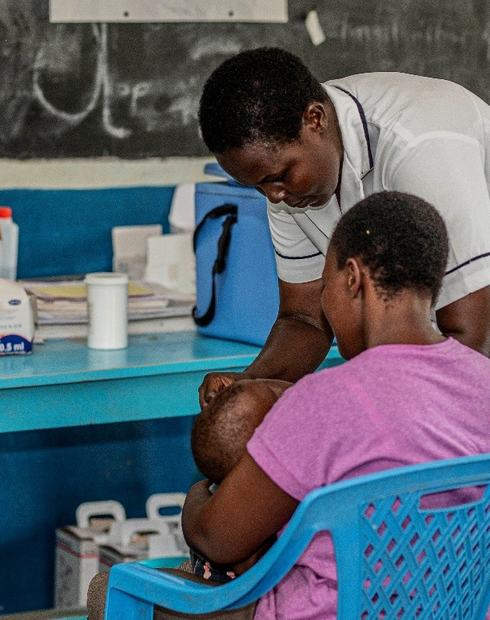
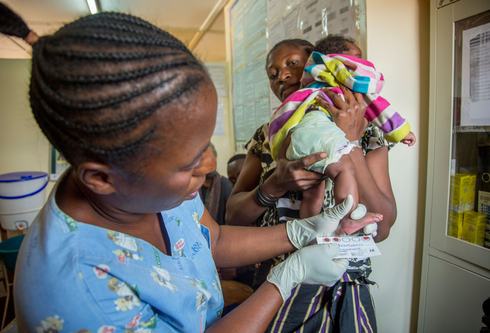
A few years ago, I visited a small clinic in rural Zambia early in the morning. The clinic had not opened yet, but there was already a long line of people waiting outside.
Women sitting quietly on wooden benches. Babies tied to their backs. Toddlers playing happily. Inside, one nurse was preparing for what was likely going to be a long day.
After standing there for a few minutes, I noticed something I have seen again and again in clinics and communities around the world.
Every single person in that line was a woman.
Some were pregnant and coming for prenatal care. Some were bringing children for vaccinations. Others were picking up medicine for parents, partners, or other family members.
This single moment captured what we already know from decades of data from communities around the world—that women are holding the health system together. And yet, too often, the health systems that depend on women are hard for women to use and they fail to address women’s unique needs.
First, more often than not, women are responsible for the whole family’s health care while also balancing childcare, eldercare, household management, and paid work. Around the world, women do 16 billion hours of unpaid care work every single day. Meanwhile, health systems often require patients to travel, wait for hours, return multiple times, and navigate separate health services on separate days.
Second, global health has long focused on women’s health primarily through the lens of pregnancy and childbirth. Maternal health is critically important. But girls and women live full lives, through adolescence, reproductive years, midlife, menopause, aging, and everything in between. Their health needs span decades, yet the evidence, financing, and care models too often remain too narrow.
That narrowness has consequences.
For too long, women have been underrepresented in research. Conditions that affect women uniquely, differently or disproportionately have received too little attention. In fact, women spend 25 percent more of their time— approximately 9 years—in poor health compared to men, and yet, only 4 percent of pharmaceutical research focuses on women’s health care needs.
By investing in women’s health and building systems that work for women, we can strengthen infectious disease prevention, primary care, research equity, and economic stability. We can improve childhood vaccination, families’ abilities to seek care early, and community resilience.
The good news is that the solutions are rarely abstract. They are often very practical—better evidence, simpler and more accessible quality health care delivery, and more control in the hands of women themselves.
That is one of the central challenges PATH’s new Strategy 2030 is built to address. Our strategy is about moving from innovation to impact, making sure breakthroughs do not just exist, but actually reach the people who need them most.
Putting women and girls at the center is an intentional strategy choice, because if a health strategy does not work for women and girls, it does not work.
That is where PATH can make a real difference.
Our new strategy focuses our work on three priorities: developing and introducing vaccines, diagnostics, and devices that reach everyone; protecting more people from infectious diseases; and strengthening and integrating health care for current and emerging needs.
Across all three, women and girls are the throughline.
For instance, when we advance HPV vaccination, we are not only preventing cervical cancer. We are correcting a longstanding failure to invest in girls’ health and futures. PATH-supported research showing that a single dose of the HPV vaccine can provide strong protection matters because it simplifies delivery, lowers costs, and expands access, especially in places where health systems are stretched.
When we support self-injectable contraception, we are not only introducing a product. We are shifting power. We are making it possible for women to decide when and where they access contraception, without depending on a clinic visit every few months.
And when we integrate prevention, screening, and treatment for multiple diseases into routine maternal care, we are not just improving efficiency. We are respecting women’s time and the reality of their lives. From the system’s perspective, HIV, malaria, and hepatitis B may fit in different categories, with different donors and reporting lines, but from a woman’s perspective, it is her health and her baby’s health. When she comes in for care, she should receive comprehensive care in one visit.
When women are healthy, everything else in the village works.

This is what it means to move from innovation to impact: After asking whether an intervention works in theory, we must also ask whether it works in women’s real lives.
So as we look toward 2030, we should be honest about what health equity requires.
That means asking better questions. Who was included in the evidence? Who can actually access the product? Whose time does the system require? Who carries the burden when care is fragmented? And does this solution help or complicate women’s lives?
These questions should sit at the center of how we define impact.
A community health worker once told me, “When women are healthy, everything else in the village works.”
That simple sentence captures what decades of global health work have shown. When women are healthy, children are more likely to thrive. Families are more economically stable. Prevention happens earlier. Health systems function better. Communities are more resilient.
Centering women and girls is not just the right thing to do. It is one of the smartest ways to build health systems that are more practical, more equitable, and more effective for everyone. Because the people holding health systems together should not have to fight so hard to be served by them.