When a patient arrives at Hamisi Sub-County Hospital with a cough and chest pain, clinician Brenda Malala begins with the same careful questions she has always asked: How long has the patient been coughing? Is there fever, weight loss, or night sweats? Could tuberculosis (TB) be the cause?
For years, those questions and clinical examination were the starting point for deciding whether a patient should be tested for TB. If Brenda suspected TB, she would send a sample for testing using GeneXpert, a machine that performs rapid, molecular diagnostic tests.
Although a GeneXpert machine can process a test in about an hour, samples must still be collected, transported to a facility, and processed. Depending on when and where the sample is collected, a patient may wait 24 hours or longer before the result reaches the clinician and the next decision can be made.
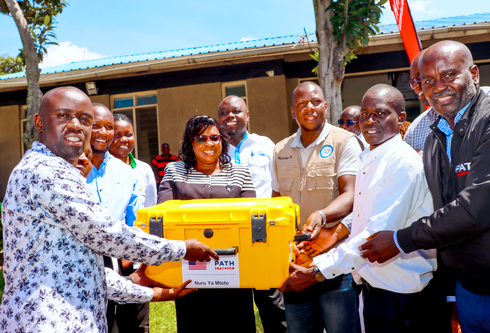
Today, Brenda has another tool: an AI-enabled X-ray machine that helps clinicians more quickly assess patients with possible TB.
This technology does not replace clinical judgment or laboratory confirmation. Instead, it is helping health workers detect risk earlier, use scarce GeneXpert tests more efficiently, and reduce the costs and distances that often prevent patients from completing their diagnoses.
The machine analyzes a chest X-ray within minutes and produces a probability score that clinicians consider alongside the patient’s symptoms, history, and examination findings. The score supports clinical judgment; it is not a diagnosis or a substitute for laboratory confirmation. At Hamisi, a score of 0.6 or above prompts further assessment, which often includes GeneXpert testing.
More information at the point of care
For Brenda, one of the biggest changes is the ability to see beyond what a patient tells her.
“[The X-ray machine] gives the clinician another set of eyes, and it gives patients another chance to be found before TB takes hold,” she says.
A patient whose symptoms initially appear less suggestive of TB may receive an X-ray that raises concern and prompts further investigation. Conversely, a lower probability score may indicate that immediate laboratory testing is not required, depending on the clinician’s assessment of the patient’s symptoms, history, and examination findings.
The result is a clearer pathway from suspicion to action: clinical assessment → AI-enabled X-ray → GeneXpert where indicated → treatment and clinical management.
For Brenda, the machine provides additional information she uses to make her decision.
“The X-ray does not make the decision for me. But when I can see what is happening in the chest, I can act with more confidence and decide which patient needs further testing.”— Brenda Malala, Hamisi Sub-County Hospital clinician

Using GeneXpert where it matters most
GeneXpert is essential for TB diagnosis, and it can even identify if the bacteria are resistant to rifampicin—one of the key antibiotics used in TB treatment.
However, testing cartridges cost approximately KES 2,000 each.
Before AI-enabled X-ray screening, clinicians might refer 10 to 20 patients a day for GeneXpert testing, based largely on clinical suspicion; however, according to a review in neighboring Sabatia, only about one in every 8 people assessed through AI-assisted screening actually required GeneXpert testing.
The aim is not to replace GeneXpert, but to prioritize it for patients whose clinical presentation and X-ray findings indicate the greatest need. In fact, the portable X-ray machine at Hamisi has reduced the cost of seeking a diagnosis and the need for patients to make additional journeys for chest imaging.
Previously, patients had to travel to the county referral hospital, spending KES 400 to KES 700 on transport and KES 500 for an X-ray. Access to imaging at Hamisi now saves them the transport costs of that referral journey and reduces the number of trips needed for diagnosis.
The County Government is now planning targeted outreach to bring screening closer to communities far from diagnostic services.
“We plan to take this machine to the communities, especially those far from diagnostic services, so that we can screen more people, save them the cost of traveling, and identify possible TB cases earlier.”— Rose Barasa, Vihiga County TB coordinator

For health workers, perhaps the most important change is how technology can support earlier detection.
Previously, TB screening relied heavily on clinical assessment, microscopy, and GeneXpert results. Vihiga has 43 microscopy sites, while GeneXpert capacity is concentrated in far fewer facilities, meaning many samples must travel through a referral network before reaching a machine. Microscopy is also less sensitive than GeneXpert and may miss some TB cases.
The AI-enabled X-ray adds another layer to this system by flagging abnormalities that may not have been obvious from symptoms alone, giving clinicians the opportunity to investigate possible TB earlier.
In cases where a patient’s symptoms, history, and X-ray findings strongly suggest TB, clinicians may begin treatment while laboratory confirmation and drug-resistance testing continue. The technology can also flag chest abnormalities that indicate conditions other than TB.
According to Rose Barasa, Vihiga County TB coordinator, the county recorded a 42 percent increase in detected TB cases in the first two quarters of 2026 compared with the same period in 2025. She attributes the increase to improved case finding. The county is now focused on ensuring that people diagnosed with TB begin treatment early.