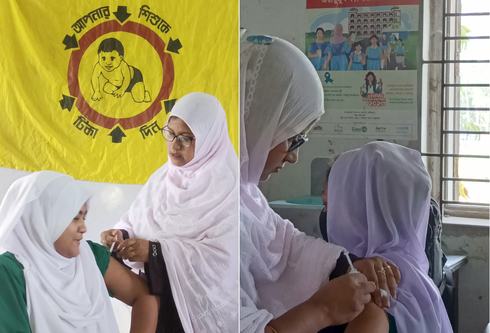
Cervical cancer is the fourth most common cancer among women globally, with more than 95 percent of cases resulting from HPV infection. HPV vaccines are highly effective; since their introduction, they have significantly reduced the incidence of HPV infections and precancerous cervical lesions. But though they have been available since 2006, HPV vaccines remain out of reach for girls and women in many low- and middle-income countries (LMICs) —where 90 percent of cervical cancer deaths occur.
In China, HPV vaccines have been available on the private market since 2016. Despite this, only an estimated 4 percent of girls between 9 and 14 years of age (the target age range for HPV vaccination recommended by the World Health Organization [WHO]) were vaccinated against the disease in 2022—and China reported the world’s highest numbers of cervical cancer cases and second highest number of cervical cancer deaths.
That’s poised to change.
In September 2025, China made a landmark public health decision by including bivalent HPV vaccine in its national immunization program (NIP). Two doses, administered six months apart, are now available for free to girls 13 years of age and older. This marks the first vaccine for adolescents ever added to China’s NIP and the first new vaccine to be added to the NIP since 2007.
Homegrown vaccines improve access
Previously, HPV vaccination in China faced numerous challenges, particularly high out-of-pocket costs and a limited vaccine supply.
A reliable supply of more affordable vaccines is crucial to protect Chinese girls and women from cervical cancer and meet the WHO’s call to, by the year 2030, fully vaccinate 90 percent of girls with HPV vaccine by age 15.
That’s easier said than done, of course. And that’s where PATH enters the story.
The inclusion of HPV vaccine in the NIP was made possible through the long-term efforts of PATH’s Sustaining Vaccine Manufacturing (SVM) program. SVM supports emerging market vaccine manufacturers in accessing state-of-the-art vaccine technology and in developing and sustainably producing vaccines that meet international quality standards and address global health priorities.
PATH provided technical assistance to two Chinese vaccine manufacturers, Xiamen Innovax Biotech Co. Ltd. and Yuxi Zerun Biotechnology Co. Ltd., with bivalent HPV vaccine candidates. We supported chemistry, manufacturing, and controls (CMC); quality; clinical; and regulatory workstreams.
For instance, we worked with Innovax to strengthen their quality management system, generate clinical evidence on the efficacy of a single-dose regimen, and assess regulatory requirements for vaccine registration in Gavi-eligible countries. We worked with Zerun to improve their quality management and pharmacovigilance systems and provide CMC, quality, and clinical advice for the WHO prequalification dossier.
“Strong quality systems are the foundation of global trust,” said Guang Gao, PATH Senior Technical Officer. “By working hand in hand with our partners, we’ve helped enable HPV vaccines that meet international standards and expand access far beyond China.”
Our work helped both vaccines—Cecolin® (Innovax) and Walrinvax® (Zerun)—obtain market approval in China and then WHO prequalification. PATH also facilitated the signing of a global access agreement for Gavi markets to enable broader global supply and lower cost of goods, ultimately leading to a significant reduction in the domestic price in China from USD 50 to approximately USD 4 per dose.
That fundamentally changed the ease of access to HPV vaccine in China. A reliable supply of high-quality, low-cost, and domestically produced HPV vaccine was a critical factor in the Chinese government’s decision to include HPV vaccination in the NIP.
“We are grateful that Chinese manufacturers are willing to enter into global access agreements, even when this means accepting lower profit margins,” said Yuan Yuan, China Country Representative, “As demand from countries increases and the cost of goods declines, this creates a win–win for manufacturers and countries. It enables broader access to this essential vaccine to protect girls from cervical cancer.”
“Strong quality systems are the foundation of global trust. By working hand in hand with our partners, we’ve helped enable HPV vaccines that meet international standards and expand access.”— Guang Gao, PATH Senior Technical Officer

Impact near and far
The addition of HPV vaccine to China’s NIP has transformed cervical cancer prevention in the country. A stable and sustainable national HPV vaccine supply will benefit an estimated 5 million school-aged girls in China annually—positioning cervical cancer infection to become a thing of the past.
Beyond China, these WHO-prequalified vaccines can be used to protect girls and women in other countries, offering protection equivalent to long-used HPV vaccines like GARDASIL®, but at a lower cost.
Expanding global access to cervical cancer prevention, particularly for the LMICs that suffer the greatest disease burdens yet also face the greatest hurdles to access, is crucial for ensuring health equity.
PATH was involved on this front, as well—for instance, we designed and sponsored a Phase 3 clinical trial of Cecolin in Bangladesh and Ghana to evaluate extended and alternative dosing schedules, which could allow countries flexibility in how to vaccinate their populations. Along with the technical assistance support provided by PATH’s SVM team, this was a key step in securing WHO prequalification and ensuring the vaccine could be procured by United Nations agencies and Gavi, the Vaccine Alliance.
And the results are plain to see: as of August 2025, Cecolin has been licensed in 23 different countries globally and introduced into the NIP programs of 9 countries outside of China.
“These remarkable achievements have the potential to change the HPV and cervical cancer landscape in China and across the world,“ said Guang Gao. “PATH is proud of all the work we’ve done with Chinese vaccine manufacturers to advance HPV vaccine access. We are thrilled to see China’s journey to tackle cervical cancer continue with the addition of HPV vaccine to the country’s NIP and to celebrate this momentous achievement.”