At the 4th International Conference on Public Health in Africa (CPHIA 2025), PATH and Impact Global Health hosted “Health Research and Development (R&D) Financing in Africa: Towards Resilience, Innovation, and Sovereignty.” This side event brought together policymakers, researchers, funders, manufacturers, and advocates to reflect on how Africa can strengthen its R&D ecosystem and drive its own innovation agenda.
The discussion came at a pivotal time. During the COVID-19 pandemic, global health R&D investment surged, fueling historic breakthroughs in vaccines, therapeutics, and diagnostics. But as the emergency faded, funding contracted by almost 40 percent between 2021 and 2024. This recurring cycle of urgency followed by neglect continues to undermine global health preparedness.
Africa’s role: From beneficiary to builder
The numbers tell a story of imbalance. According to G-FINDER—a global survey that tracks annual investment into R&D for new products and technologies to address priority global health challenges—between 2015 and 2024, global health R&D received an estimated US$86 billion in funding.
R&D investment for neglected diseases accounted for $42 billion, emerging infectious diseases for $37 billion, and sexual and reproductive health for just $3.9 billion. Most of this investment was crisis driven. When emergencies end, support fades, leaving critical areas like reproductive and maternal health underfunded. Even within neglected disease R&D (which saw a third consecutive year of decline in 2024), 73 percent of funding continues to flow toward HIV, tuberculosis (TB), and malaria.
Meanwhile, conditions affecting millions of women, such as endometriosis and fibroids, remain largely overlooked.
Participants in our session agreed that Africa has the potential, and the responsibility, to lead its own R&D agenda. South Africa offers a powerful example, investing in health R&D over the past decade and strengthening its capacity for HIV, TB, malaria, and COVID-19 R&D.
However, across the continent, limited domestic financing, fragmented data systems, and donor dependency remain barriers to progress. As one panelist emphasized, “R&D isn’t just about science, it’s about sovereignty.”
Every $1 invested in health R&D delivers $405 in social and economic returns. By 2040, such investments could save 40 million lives and avert 2.8 billion years of disability globally.
Financing resilience: Closing the gaps
The engaging conversations delved into two main issues: financing resilience and strengthening governance and leadership. The session’s first theme focused on mapping R&D investments and building financing resilience. While the global health R&D pipeline is expanding, with nearly 800 pipeline candidates for neglected diseases and more than half in clinical development, funders need to strike a balance between advancing the maturing pipeline through costly late-stage clinical trials to the finish line and replenishing the pipeline with new candidates.
Panelists explored the “valley of death” faced by many locally developed diagnostics, promising innovations that stall before reaching the market. Innovative financing models such as blended finance, pooled regional funds, and domestically anchored mechanisms were identified as key to bridging this gap.
Participants also called for greater alignment between national R&D financing priorities and the Africa Centres for Disease Control and Prevention’s (Africa CDC’s) Health Financing Strategy, ensuring that resource flows support long-term regional resilience.

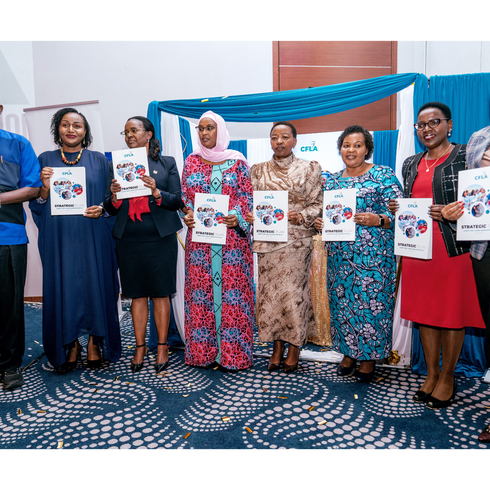
PATH and Impact Global Health teams at CPHIA. Photo: PATH/Susan Lin.
Strengthening R&D governance and leadership
The second discussion theme centered on governance and leadership. Panelists highlighted the importance of coordination among the Africa CDC, the African Union Development Agency-NEPAD, and the African Medicines Agency to advance coherent R&D policies, strengthen accountability, and accelerate access to African-made innovations.
Embedding Africa CDC’s continental R&D prioritization framework into national planning and budgeting processes was identified as a critical step toward greater alignment and ownership. The discussion also underscored the role of advocacy organizations and policy networks in influencing financing priorities and driving accountability for sustained R&D investment.
Made in Africa: Turning research into impact
A recurring theme throughout the discussion was the “Made in Africa” approach, an emerging model that integrates research, local manufacturing, and market access. By combining technology transfer, regulatory alignment, and innovative financing, the initiative aims to ensure that African solutions are developed, produced, and scaled within the continent.
Currently, more than 90 percent of medicines and diagnostics used in Africa are imported, leaving the region vulnerable to supply shocks. Strengthening regional R&D ecosystems and manufacturing capabilities is therefore not just an economic choice; it’s a strategic imperative for health security.
PATH, supported by Unitaid and a coalition of African and global partners, launched the Manufacturing to Accelerate Diagnostic Excellence (MADE) in Africa project to address this imbalance. Over the next four years, MADE will work to strengthen and expand Africa’s diagnostic manufacturing ecosystem
Charting the way forward
Panelists and participants outlined clear priorities to sustain momentum:
- Invest locally. Governments should commit at least 1 percent of gross domestic product to R&D.
- Collaborate regionally. Pool resources, harmonize regulations, and build shared manufacturing hubs.
- Think beyond emergencies. Establish long-term, predictable financing mechanisms such as innovation funds, blended finance, and impact bonds.
- Embed access in innovation. Ensure that new health technologies are affordable and accessible from day one.
- Prioritize country needs. R&D priorities must be grounded in country needs, informed by community perspectives, and aligned with locally defined goals rather than external funding interests alone.
Africa stands at a decisive turning point. The continent has the expertise, institutions, and ambition to lead global health innovation, but sustained investment and political commitment must follow. The message from CPHIA 2025 was clear: R&D is not optional; it is central to resilience. The next health emergency is not a matter of if, but when. Africa can choose to lead the response.