On December 10, 2025, PATH’s Center for Advocacy and Policy, in collaboration with Kenya’s Ministry of Health, hosted "The Money Behind the Mission: Financing PHC for UHC,” the second edition of the Kenya Primary Health Care Webinar Learning Series.
The conversation focused on the financing of primary health care (PHC), a subject that has become increasingly important as Kenya works to strengthen its health system and move closer to achieving universal health coverage (UHC).
The webinar provided a space for health leaders at national and subnational levels, civil society organizations, global partners, and other health actors to reflect on Kenya’s current health financing landscape and implications on PHC, informed by practical experiences from across the country.
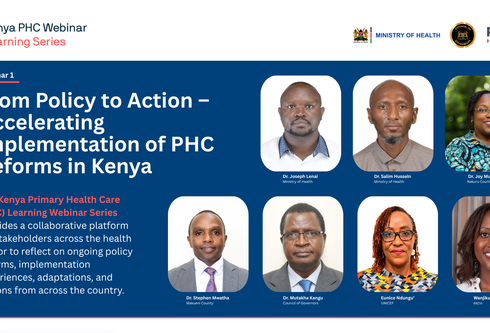
Moderated by Rachel Ndirangu, PATH’s Regional Director for Advocacy and Policy, the discussion featured contributions from Dr. Joel Gondi, Director of Primary Health Care, Ministry of Health; Halima Yusuf, Technical Officer for Health Financing, Ministry of Health; Terry Watiri, Health Economist, Ministry of Health; Dr. Rebecca Musyoki, Head of Health Financing, Nairobi County; Dr. Elizabeth Wangia, Health Policy and Financing Specialist, World Bank; and Melissa Wanda, Advocacy and Policy Manager, PATH.
Kenya’s current financing landscape
Speaking at the opening, Dr. Gondi highlighted Kenya’s bold commitment to ensuring that every citizen can access health services, stressing that financing is central to this ambition. He further underscored the pivotal role of sustainable financing as a vital cog in the PHC wheel, emphasizing the need for clarity and alignment among all stakeholders on what the mission is as Kenya advances robust PHC-oriented policy and financing reforms.
Halima Yussuf highlighted Kenya’s current financing landscape, which is characterized by a mix of government allocations, donor support, and out-of-pocket spending. She addressed key challenges that Kenya faces, such as underfunded Abuja Declaration targets, high out-of-pocket costs, low insurance coverage, and the shifting global health financing environment. She noted that Kenya is pursuing reforms aimed at reducing financial barriers and strengthening domestic financing to advance UHC.
Building on this, Terry Watiri highlighted the Kenya Primary Health Care Fund as a key government priority. She explained that the fund is designed to grow in line with the number of people registered and is expected to be prioritized in the upcoming national budgets. While progress has been made, she acknowledged that gaps remain, particularly in ensuring adequate funding and standardizing budget allocation and tracking across counties.
“PHC financing has been invisible in health and budgets, making it difficult to track investments. We need to align on clear metrics for PHC financing.”— Terry Watiri, Health Economist, Ministry of Health

Linking local to global: County and partner perspectives
Dr. Musyoki provided a county perspective through Nairobi County’s experience. She noted that the Facilities Improvement Financing Act empowered health facilities to generate and retain their own funds, granting them autonomy and the legal authority to act as procurement entities.
Nairobi County has also worked to ensure that providers understand how payment systems function and how they can claim reimbursement. Efforts have been made to expand registration for social insurance funds, strengthen collaboration with the Social Health Authority, and enhance claims tracking and payment processes.
Dr. Musyoki emphasized that partnerships have been crucial in enhancing public finance management and ensuring that resources are used effectively to support the county’s UHC goals.
“For the mission to succeed, we must unblock barriers to funding flows to the lowest PHC level and optimization at all levels, like in the example of Nairobi County.”— Dr. Rebecca Musyoki, Head of Health Financing, Nairobi County

Adding a global perspective, Dr. Wangia stressed that resource alignment goes far beyond pooling funds. It requires strong leadership, effective governance, and accountability. She highlighted the need to reduce fragmentation so that the true impact of investments can be demonstrated, underscoring the importance of joint planning at both national and county levels.
Dr. Wangia urged partners to channel support into existing PHC funds rather than creating parallel programs that risk duplication. She further called for investment in capacity-building, particularly in planning, technical expertise for facilities improvement financing, and the strengthening of primary care networks.
Finally, Melissa Wanda emphasized the importance of boosting domestic investment, supported by robust accountability frameworks. She underscored that governance and accountability matter just as much as financial resources, noting that the success of any financing model ultimately hinges on strong governance. She further highlighted the critical role of civil society leadership in championing sustainable financing and accountability, ensuring that investments address real needs and deliver measurable results.
The full English webinar recording can be accessed here.
Looking ahead
The Kenya Primary Health Care Webinar Learning Series is set to continue in 2026, with plans underway to explore harnessing data for PHC quality improvement, driving digital transformation for stronger PHC, and advancing equitable PHC through civil society engagement.