Nyamira County in western Kenya ranks among counties with the country’s highest tuberculosis (TB) burden, with an estimated incidence of 426 cases per 100,000 people according to data from the Kenya National TB Program. This is compounded by a high HIV/TB coinfection rate, which was 22 percent in 2024.
Nyamira County offers free integrated TB services in 140 of its 200 active health facilities, with a coverage rate of 70 percent. Despite this, 40 percent of expected TB notifications are missed annually. This is due to many factors: delays in seeking care, lack of awareness about TB, TB/HIV-related stigma, and long working hours for laborers that make it difficult to seek care during health facility open hours.
“People fear going to the hospital when they suspect they could be suffering from TB because they often closely associate it with HIV,” says Joshua Migosi, a community health promoter (CHP) in Nyamira County.
Joshua is among the 1,379 CHPs empowered to deliver community TB services under a PATH-led project in Nyamira County, funded by the Astellas Global Health Foundation. This project is working to increase early TB identification through community-level screening. Those with TB symptoms are referred to health facilities for follow-on diagnosis and treatment or prevention.
Through the project, CHPs were trained and mentored on TB detection and care during household visits. This included training on screening for symptoms and making referrals to health facilities for follow-on diagnosis and care. Additionally, training covered health education for communities, enabling CHPs to share how TB is transmitted as well as the importance of completing treatment and prevention regimens.
CHPs also learned about stigma and how it often prevents people from seeking care.
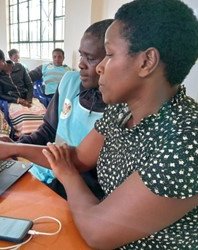
As part of the project, CHPs were provided smartphones that they use to collect, manage, and report community TB data through Kenya’s digital electronic Community Health Information System (eCHIS) platform. Through the eCHIS application, CHPs in Nyamira can now register households, screen individuals for TB symptoms, and make referrals to health facilities in real time. The system also guides them through the screening process and generates follow-up tasks, helping ensure that people with TB symptoms are linked to further evaluation and treatment if needed.
Equipped with this new knowledge and digital tools, CHPs returned to their communities with a renewed sense of confidence. They began integrating TB screening into every household visit, paying closer attention during conversations with families and community members.
CHPs also began conducting health education sessions during community outreach sessions and household visits, helping to counter myths and misconceptions about TB that often prevent people from seeking services at health facilities.
“We used to walk past TB. Now we stop it.”

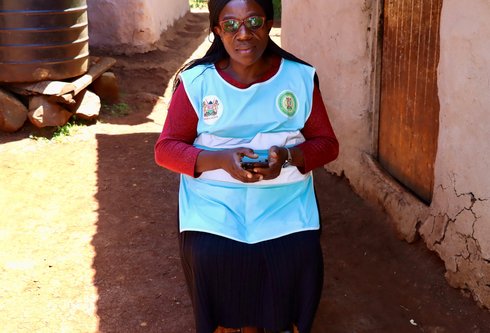
Edward Otinga was trained through the project to support TB screening, referral, and follow-up at the community level. Photo: PATH/Meshack Ariri.
For 47-year-old Edward Otinga, a CHP since 2013, the training marked an important step in his work to reduce TB in his home village, Nyaigwa.
Before this, he and many other CHPs understood TB mainly as a disease marked by a persistent cough. Few realized how easily it spreads within households or how preventable it can be when detected early.
“Before the training, I did not know that simple symptoms like night sweats or unexplained weight loss could signal TB. Now I can act quickly and protect a lot of families.”— Edward Otinga, CHP

Edward recalls a moment when this training made a personal and life-changing difference. His friend Eric had developed an ongoing cough and was losing weight. Remembering some of the symptoms of TB he had learned during the training, Edward encouraged Eric to visit the health facility to rule out TB.
After some hesitation, Eric agreed.
Edward accompanied his friend to the hospital, where testing confirmed that Eric had TB. Edward supported his friend throughout the treatment journey, reassuring Eric that TB is curable when medication is taken consistently and encouraging him to be consistent with his prescribed treatment regimen and attend all his appointments.
Edward also checked in with Eric’s family members, speaking to them about TB and how it is transmitted and referring them to a nearby facility to be screened. While Eric’s family members tested negative for TB, they were prescribed TB preventive therapy to reduce their risk of developing TB.
With time, Eric successfully completed his treatment and was declared free from TB. Edward continues to actively support the 389 individuals living in his community with TB and other health services.
A trusted community TB champion
As most residents of Nyaisa village in Nyamira County relax in their homes at the end of the day, CHP Joshua Migosi puts on his light blue jacket and prepares for his routine household visits. Armed with a smartphone and a community health kit, he sets out before dusk to check on families in Nyaisa village, where he provides essential health services to 483 people in his community.
During one of his routine household visits, Joshua met Isaac (name changed for privacy), a middle-aged man resting under the shade of a tree. Isaac had been waiting patiently to speak with Joshua, who is well known and trusted in the village.
Guided by eCHIS, Joshua assessed Isaac’s health status, asking a series of symptom screening questions to better understand Isaac’s condition. He noted that Isaac had a persistent cough, had been experiencing chest pains for more than three weeks, and had lost weight. Because these symptoms can be indicative of TB, Joshua advised Isaac to visit the nearest health facility for further evaluation and immediately initiated a referral through his smartphone for continued care.
The following day, Joshua received a follow-up task on his smartphone, prompting him to check on Isaac. By then, Isaac had visited the health facility and been diagnosed with pulmonary TB, a type of TB that affects the lungs and spreads easily through coughing. During this visit, Joshua talked to Isaac about the importance of continuing to take his TB medication as prescribed at the health facility.
Joshua also spoke to three members of Isaac’s household, explaining the importance of visiting the health facility to be screened for TB. Joshua accompanied them to a nearby facility. Following examination and testing, he was relieved to learn that none had TB.
They were given TB preventive medicines and advised to support Isaac with his treatment by ensuring he takes his treatment daily and attends all clinic appointments.
A TB-free future

A CHP during a TB screening in Nyamira County. Photo credit: PATH.
In 2025 alone, CHPs in Nyamira County reached and screened more than 107,990 individuals—28 percent of all people screened for TB in the county that year. The project partners closely with Nyamira County’s Department of Health to bring TB and other health care services closer to people, thereby strengthening the county’s overall primary health care system.
Nyamira County TB, Leprosy, and Lung Health Coordinator, Felisters Muma, observed a rise in the number of people screened and referred by CHPs to health facilities for TB services since this work started. In 2025, over 85 percent of the household contacts who started on TB preventive therapy were referred by CHPs, compared to 81 percent in 2024.
Muma attributes this progress to the training, mentorship, and supervision provided to CHPs by Nyamira County Department of Health Services in collaboration with partners like PATH.
She is optimistic that, with dedicated CHPs like Joshua and Edward, Nyamira County is on track to meet its 2026 target of identifying and treating at least 2,000 people with TB.
“I encourage my community members that ‘TB ina Tiba—TB is treatable.’”— Edward Otinga, CHP

Reflecting on his work, Joshua now says, “I am happy that I helped prevent the further spread of TB in my community. Without my intervention, Isaac’s health would have continued deteriorating at home, unaware of the danger of spreading TB to his elderly parents, nephew, and even neighbors.”
As for Edward, the message is simple: “I encourage my community members that ‘TB ina Tiba—TB is treatable.’ ”