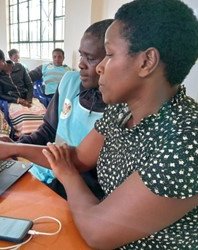
Lilian Bonareri’s daily schedule is often busy. As a Community Health Promoter (CHP) in Nyamira County, Kenya, no day looks quite the same. On any given day, Lilian could be visiting households within her community; conducting health assessments using Kenya’s community health mobile app; delivering a health talk; offering first aid; referring community members to health facilities for further screening or other services; or attending community dialogues at her local community health unit.
Her service to her community as a CHP—ensuring that everyone in her community can access primary health care—gives her a sense of purpose.
However, Lilian did not always know that becoming a CHP would be her future career. When she tested positive for HIV in 2005, she felt like her world had collapsed.
“I had big dreams for my life and my children,” she recalls. “But when I got the news, everything shattered before my eyes.”
Lilian’s journey with HIV began long before her diagnosis. In 1997, her husband passed away from what was believed to be tuberculosis (TB)-related complications. Unknown to Lilian, he had been living with HIV and never disclosed it. After his death, her sister-in-law and mother encouraged her to get tested—but the road to diagnosis was painful and filled with stigma. At one health facility, she was treated coldly and chose to walk away. Eventually, with her family’s support, she made it to Mbagathi Hospital in Nairobi, where she finally received confirmation: she too was HIV positive.
The emotional toll was heavy. Even close relatives turned away from her. She remembers her sister-in-law’s children warning her not to visit their home, fearing she would "infect" them. But Lilian did not let the stigma define her.
With support from her siblings and mother, she accepted her status and began lifesaving treatment in 2005, slowly rebuilding her life. Her children, then just 14 and 8 years old, were in shock when she told them about her status, but their response and support warmed her heart.
“Every morning at breakfast, they would remind me, ‘Mum, hujakunywa dawa’—‘Mum, you haven’t taken your medicine.’

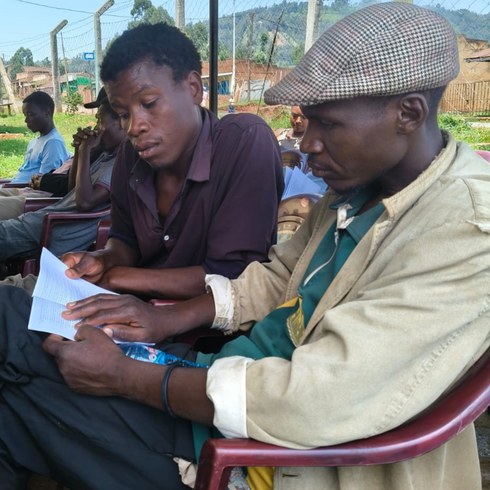
Lilian conducts a household visit. Photo credit: PATH.
Lilian’s experience gave her a sense of purpose. In 2018, she decided to become a CHP; now 52, she lives and works in Ogango village in Nyamira County. Through household visits, health talks, and support groups, she’s turned her personal story into a beacon of hope for others living with HIV. As a CHP, she shares her journey with others in her community to break the stigma around HIV, which is a major barrier to accessing testing services and follow-on care.
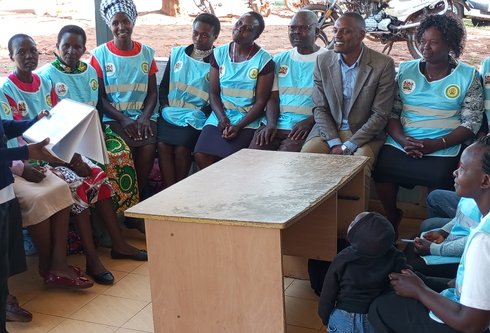
Thanks to training and support from PATH—made possible through funding from the Astellas Global Health Foundation (AGHF)—Lilian and 724 other CHPs in Nyamira County completed trainings in 2025 that equipped them with skills to better educate their communities about HIV, TB, and the importance of testing and treatment.
“The training gave us confidence and the knowledge we needed to serve our people better,” Lilian says proudly.
The AGHF-funded project also strengthens community digital health and supply chain platforms and advocates for policy changes that ensure CHPs in Nyamira County have a strong foundation to provide high-quality services.
“We need to normalize conversations with our children about HIV—how to prevent it, how to care, and how to treat it without shame.”— Lilian Bonareri

Lilian’s story shows how lives can be transformed as Kenya continues to expand community health systems and further integrate HIV services into primary health care. Beyond her formal work, Lilian also participates in church-based groups for widows and widowers, helping raise awareness around HIV stigma, disclosure, and support.
Today, Lilian’s story is not one of loss, but of purpose. With AGHF support, Lilian and hundreds of CHPs just like her have gained the tools to ensure that people living with HIV can access the care they need to lead healthy lives, care for their families, and contribute to their communities.