In 2005, Nambaje Elias learned he had chronic kidney disease (CKD). A year later, with support from the government of Rwanda, he traveled to India for a kidney transplant. It was an exhausting, life-altering experience he does not wish on anyone. At the launch of the expanded Healthy Heart Africa (HHA) program, Elias shared his story with quiet urgency. His message was clear: We must bring awareness and screening closer to the people, before it’s too late.
His story is not unique. In Rwanda and sub-Saharan Africa, CKD is a growing but under-recognized threat. CKD progresses silently, with many unaware of their condition until it reaches a critical stage. It is closely linked with hypertension and diabetes, two noncommunicable diseases (NCDs) steadily rising in Rwanda. According to the World Health Organization’s 2024 Vital Statistics Report, nearly half (47.7%) of all deaths in health facilities in Rwanda were due to NCDs.
Without early detection and long-term management at the primary health care level, many people will only receive care once the disease is advanced, treatment options are limited, and costs are high.
Healthy Heart Africa: Building on a strong foundation of regional experience

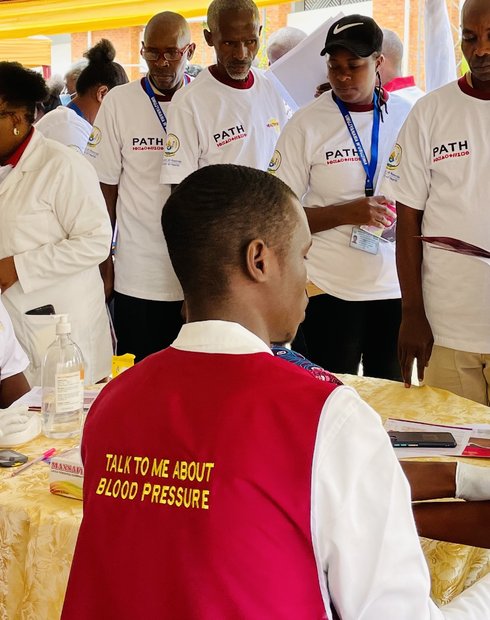
A community health care worker conducts a live screening demonstration with Dr. Florence Sibomana, NCDs Program Lead at PATH Rwanda. Photo: PATH/Kanyarwanda Arts.
The HHA program, launched in Kenya in 2014 and now active in nine African countries, brings over a decade of experience in expanding access to hypertension and diabetes services. Through this regional platform, HHA has reached millions by conducting screenings, training health care providers, and strengthening primary health care systems.
Rwanda joined this effort in 2022, introducing HHA Phase 1 to reinforce primary-level NCD care. During this phase:
- More than 810,000 people were screened for high blood pressure.
- 8,174 were diagnosed and linked to care.
- 336 health care providers were trained in hypertension and diabetes management.
- 60 NCD clinics and 52 peer support groups were established to keep people engaged in long-term treatment.
These achievements created a strong foundation, but also revealed critical gaps, including high client volumes, limited staff, and inconsistent follow-up, which result in missed opportunities for early diagnosis and continuity of care. Limited CKD screening at the primary health care level, combined with the absence of CKD data in national systems, further obscured the true burden of disease.
“For us, these are not just numbers; they represent lives saved,” said Amos Mugisha, PATH Tanzania Country Director, underscoring the dedication of frontline health workers and the value of strong partnerships.
Guided by these lessons, Rwanda is now advancing a new chapter that integrates CKD prevention, screening, and management directly into primary health care, bringing life-saving services closer to communities.
A strategic evolution in NCD care

Dr. Francois Uwinkindi (RBC), Amos Mugisha, Margaret Kigwe (AstraZeneca), and Jean Leonard Sekanyange (Vice Mayor of Gatsibo District) cut the ribbon to mark the launch of the expanded HHA project in Rwanda. Photo: PATH/Kanyarwanda Arts.
To address the persistent challenges, PATH, the Rwanda Biomedical Centre (RBC), and AstraZeneca partnered to launch Phase 2 of HHA, focusing on integrating CKD into Rwanda’s approach to NCD care. The expansion aligns with the World Health Assembly’s call to strengthen early CKD detection and long-term treatment.
Phase 2 will be implemented in Gakenke, Gatsibo, and Nyarugenge districts and will strengthen services for 60 primary health care facilities. The work includes:
- Training 3,000 community health workers (CHWs) across 750 villages to conduct screening, referrals, and follow-up for hypertension, diabetes, and CKD.
- Training 130 health care providers on updated protocols for integrated NCD care.
- Developing a CKD registry to record CKD data and integrate it into Rwanda’s national health information system.
“Seeing CKD integrated into this program and extended to the primary health level gives us renewed confidence,” Elias said. “Early detection will ensure timely interventions and raise awareness of NCDs and their risk factors.”
Professor Claude Mambo Muvunyi, Director General at RBC, echoed this urgency.
“The Rwandan government is highly committed to tackling NCDs through a decentralized approach that emphasizes early detection, enhanced capacity-building, and financial accessibility through community-based health insurance.”
“The Rwandan government is highly committed to tackling NCDs through a decentralized approach that emphasizes early detection, enhanced capacity-building, and financial accessibility through community-based health insurance.”— Professor Claude Mambo Muvunyi, Director General, RBC

CHWs: The frontline of prevention

Community health care workers receiving kits that will support them in community-based screening for hypertension and diabetes. Photo: PATH/Kanyarwanda Arts.
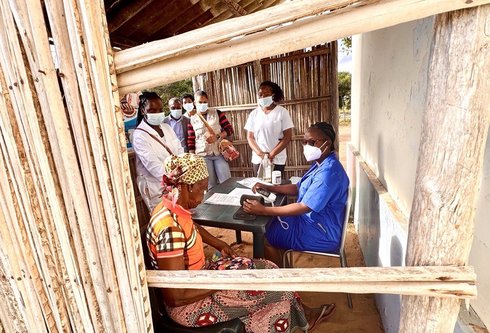
A cornerstone of HHA Phase 2 is empowering CHWs to conduct blood pressure and glucose screenings at the household level and provide patient education, referrals, and follow-up. CHWs receive kits that include weight and height scales, blood pressure monitors, glucometers, measuring tapes, and rechargeable batteries, thereby reducing the barriers of distance and cost.
To further support health systems, PATH and its partners have developed practical training manuals and clinical protocols for early detection and management of CKD in primary health care settings. So far, 25 health care providers in three districts have been trained as master trainers, allowing them to cascade training to health care providers in their respective districts.
“The tailored CKD training was transformative. It will strengthen our diagnostic skills, improve patient management, and reinforce timely referrals. We are now better equipped to identify CKD cases before they reach advanced stages,” said Rachel Nyiransengimana, an NCD nurse at Kiziguro District Hospital.
Dr. Florence Sibomana, PATH’s Senior Program Officer for NCDs, emphasized that integrating kidney care into HHA allows more people at risk for NCDs to access essential care closer to home, easing the impact of chronic diseases across Rwanda.
“The tailored CKD training was transformative. It will strengthen our diagnostic skills, improve patient management, and reinforce timely referrals. We are now better equipped to identify CKD cases before they reach advanced stages.”— Rachel Nyiransengimana, NCD nurse, Kiziguro District Hospital


Leaders from AstraZeneca, RBC, PATH, Gatsibo District, and Rwanda’s Ministry of Health join hands to mark the launch of the expanded HHA program in Rwanda. Photo: PATH/Kanyarwanda Arts.
The success of the HHA program in Rwanda is rooted in the strength of its partnerships. This strength is reflected in PATH, AstraZeneca, and RBC coming together with a shared vision: to transform NCD care through innovation, integrated service delivery, and community-led action. Their collaboration exemplifies the power of public–private partnerships to advance health equity and build resilient health systems.
District leaders have also played a vital role by embedding health promotion into local development plans, so the work is not only impactful but sustainable.
“HHA is not just a program; it is a scalable model for strengthening primary health care systems, built on the power of public–private partnerships,” noted Deepak Arora, Country President for AstraZeneca’s African Cluster. “By embedding prevention, early detection, and treatment into primary care, we are supporting Rwanda’s national health goals while contributing to Africa’s Agenda 2063 and the global push for universal health coverage. This is how we accelerate meaningful, lasting progress.”
For people like Elias—and for thousands more across Rwanda—this expansion means something simple yet profound: a better chance to be diagnosed early, treated close to home, and supported to lead healthier lives. It is a reminder that lasting progress begins with care that reaches every household, one community at a time.
“HHA is not just a program; it is a scalable model for strengthening primary health care systems, built on the power of public–private partnerships.”— Deepak Arora, Country President for AstraZeneca’s African Cluster